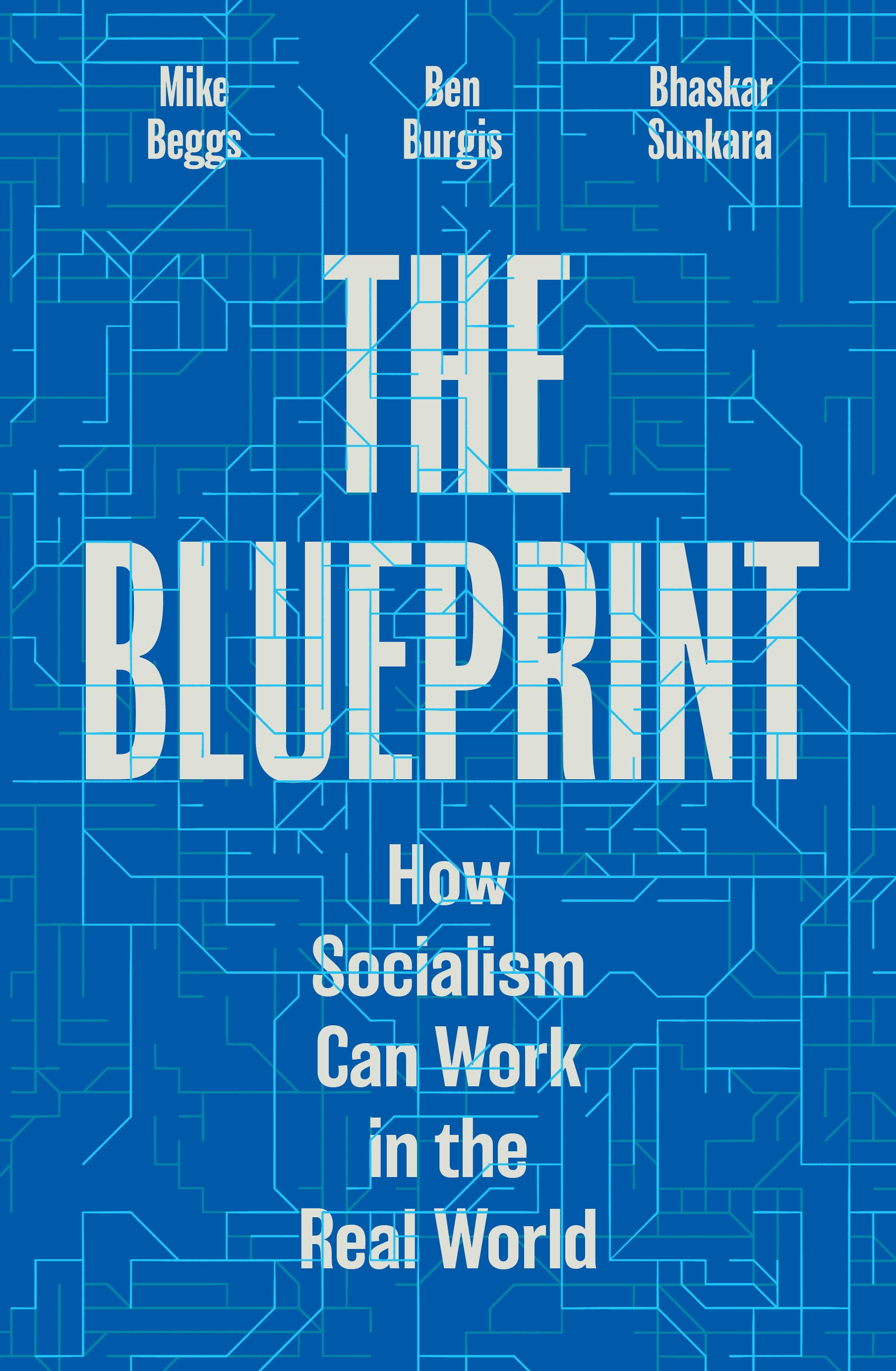
The Blueprint

How socialism can work
in the real world

Mike Beggs · Ben Burgis · Bhaskar Sunkara

Cover of The Blueprint by Mike Beggs, Ben Burgis, and Bhaskar Sunkara
Read the argument
01 The proposition

Socialists need to explain how a modern economy could operate after capitalism.

It’s not enough for socialists to show that capitalism is a system built on inequality, domination, and exploitation. We need to show that there is a viable alternative to capitalism that can be won in our lifetimes.

Over the course of more than 400 pages, The Blueprint lays out a radical model of socialism that goes beyond both central planning and social democracy. A large state sector provides noncommodified goods, while a regulated market sector composed of democratic, worker-controlled firms produces goods and services in response to consumer demand.

The model retains markets because prices, competition, and consumer choice solve real coordination problems. But it rejects capitalism on egalitarian and democratic grounds: none of that requires a separate class of owners with authority over production, investment, and the lives of ordinary workers.

02 The institutional model

How a socialist economy is organized.

01

Productive wealth is socially owned

  • Individuals cannot buy and sell ownership claims over firms.
  • Democratic firms are custodians and users of productive assets, not their owners.
  • State agencies directly control assets used in the noncommodified sector.
  • Capital income from commodity production flows through public banks to the public purse.

There is no socialism without social ownership. Under capitalism, the owners of the means of production get to make investment decisions, take the surplus their workers produce, and either directly administer their firms or appoint the directors who do. In the proposed system, the entrepreneurial work of capitalists is taken up by public banks and the workers themselves.

In our system, worker-members elect their own directors and are custodians of the equipment they use to produce goods and services. They make production decisions as a collective, but they can’t sell their firm, convert its assets into private wealth, or employ wage labor.

You can think of it as members of democratic firms renting the means of production from society as a whole, through the public banks that finance them, but still controlling the fruits of their labor.

02

Markets coordinate much of commodity production

  • People spend personal incomes on the goods and services they choose to buy.
  • Firms respond to demand rather than fulfilling detailed production orders.
  • Competition transmits information about price, quality, and changing preferences.

There were markets before capitalism, and we think there are ways to harness the power of markets while limiting their pathologies in any system that will succeed it. In our model, markets, prices, and money continue to exist, but capital no longer exists as a privately owned source of control over other people’s work.

Markets perform useful functions that shouldn’t be conflated with capitalist ownership of the means of production. Prices make economic calculation possible: firms can compare the costs of different inputs and techniques. But calculation is only part of the coordination problem. An economy must also discover what people want, give producers reasons to respond, and create space for new products and production methods to emerge.

Consumer choice matters because people care about quality, design, convenience, reliability, and many other things no plan can specify in advance. Demand for a firm’s particular product supplies information and gives other firms a reason to do better.

But The Blueprint rejects the false choice between markets and planning. A functioning market socialist system—with social ownership, worker control, and competitive allocation—creates the material surplus, the embedded information, and the dispersed initiative that make large-scale coordination and democratic decision-making in key sectors possible.

03

Workers control production through democratic firms

  • Worker-members elect directors and hold them accountable.
  • Directors appoint and supervise day-to-day management.
  • Members receive a regular wage and a share of residual income.
  • Firms compete, cover costs, and make investment proposals.
  • Unsuccessful firms can contract or fail.

Under socialism, in contrast to the dictatorship of the capitalist workplace, workers will self-govern their own firms.

In a small firm, members may decide many questions in a form that resembles direct democracy. In most other firms, representative democracy is the expected form of governance. Workers would periodically elect directors and ratify or amend operating agreements, and directors would appoint managers. Though managers would still exercise administrative authority on the shopfloor, we’d imagine a workplace far more egalitarian, with ordinary worker-members empowered to vote on pay scales and to replace the directors above them. Authority ultimately runs upward from the workforce rather than downward from private owners.

Worker control does not give any one firm license to ignore people outside it. Democratic firms still have to win customers, meet wage benchmarks, follow environmental and safety rules, and justify their use of social wealth to public banks.

Institutional comparison

Who governs the firm?

Ultimate authority
Owners and their appointed directors
Worker-members and their elected directors
Management
Accountable to owners
Accountable to worker-members
Workers
Hired employees
Members of the firm
Regular income
Market wage or salary
Wage meeting at least the labor board benchmark
Residual income
Paid to owners
Paid to worker-members
Productive assets
Private property of owners or shareholders
Social wealth entrusted to the firm, owned collectively by the public
Investment finance
Retained profit, private debt, and equity
Partnership with one or more public banks
Market discipline
Must cover costs and meet obligations
04

The labor board keeps competition on the high road

  • A national labor board establishes wage and condition benchmarks.
  • Firms may pay above the benchmark.
  • Benchmarks prevent competition through a race to the bottom and encourage productivity gains.

Competition between democratic firms is a good thing, but it needs to be regulated. Left to their own devices, firms could keep their costs low by suppressing wages and intensifying work—self-exploiting to capture more market share.

Wage benchmarks set by the labor board close off that low road and push firms toward finding better routes to success. A firm that cannot pay the benchmark is not viable simply because its members are willing to sweat their own labor. Competitive pressure is redirected toward the pursuit of productivity through innovations and better ways of organizing work.

The board does not set every wage for every possible occupation. Instead, it establishes a schedule of benchmarks by job category, with room on the scale to reflect skill, experience, and regional differences. We imagine a system no more complex than Australia’s roughly one hundred industry awards. Firms remain free to pay premiums for scarce skills, unpleasant work, extra effort, or other reasons their members approve.

05

Public banks allocate investment and distribute risk

  • The financial system is entirely public.
  • Democratic firms get credit from public banks to invest.
  • Regular banks assess returns and risks; development banks fund projects valued for other reasons.

How should democratic firms finance themselves? They definitionally can’t do so by selling equity, as that would give outsiders control and a claim on the surplus they produce. Yet financing investment from worker-members’ personal wealth would concentrate their risks, and relying on fixed debt would leave their incomes exposed to every fluctuation in sales and costs.

In The Blueprint, then, public banks finance firms’ use of productive assets through agreements whose payments rise and fall with the firm’s income, cushioning members from short-term shocks. Because each bank holds a diversified portfolio, it can spread firm-specific risks that a single workforce cannot bear.

Regular banks finance projects expected to clear a commercial threshold. Development banks can support investments valued for regional employment, new industries, environmental goals, or other developmental priorities even when they are not expected to earn a competitive commercial return.

Investment architecture

The public-bank partnership

Finance
Central banksets total credit
wholesale funds
Competing public banksassess projects and pool risk across firms
finance and risk sharing proposal and variable payments
Democratic firmaccepts terms, uses assets, and remains financially accountable
Governance inside the firm
Worker-membershold democratic authority
elect
Directorsset broad strategy
appoint and monitor
Managementruns day-to-day operations

Financial authority: a bank may approve or refuse finance and set contractual terms.

Workplace authority: worker-members govern the firm.

Public banks pool risk across many firms. A failed project does not financially ruin its workforce, but firms without a viable future are not kept alive indefinitely.

The public treasury owns the banks and receives capital income. Firms may approach more than one bank and change partners.

06

Many essential goods belong in an expansive state sector

  • State agencies provide goods poorly suited to commodity production.
  • Health, education, infrastructure, energy, transport, and other commanding heights can be directly planned.
  • State agencies use money prices and budgets to compare alternative uses of labor and resources.

Markets work best when a product is a discrete package whose benefits go to the buyer and whose costs are reflected in its price. Many essential activities do not fit that description. Energy and communications networks are natural monopolies. Knowledge and culture can be shared without being used up. In health and education, people often cannot assess what they need or judge quality as ordinary consumers.

State agencies can directly provide health care, education, care work, infrastructure, energy, transport, and other activities whose provision should not depend on profitability or an individual’s ability to pay. Publicly funded institutions can still retain substantial local and professional autonomy.

Democratic politics determines which activities should be removed from commodity production, which should remain in regulated markets, and which should use hybrids such as public purchasing, subsidies, or socialized markets.

07

Equality is built into production and reinforced through public policy

  • Private claims to income from ownership of firms disappear.
  • Wage benchmarks compress labor incomes before taxes.
  • Progressive taxes, transfers, and public services narrow remaining differences.
  • Publicly owned housing provides secure tenure without speculative windfalls.

Socialism doesn’t require everyone to get the same wages. Pay disparities may attract people to difficult work, reward effort, or encourage more people to train in scarce skills. But they arise inside a radically more equal structure: nobody receives income merely by owning a firm, wage floors are set by the state, and incomes remain subject to progressive taxation.

Public services and income guarantees protect people unable to work, temporarily unemployed, retired, studying, or caring for others. A modest unconditional floor prevents destitution, with more generous benefits responding to particular needs.

Land and housing are public property. Residents pay rent reflecting location and type, enjoy secure tenure, and can renovate their homes, but do not bear speculative risks or capture arbitrary windfalls.

Together, social ownership, compressed wages, income redistribution, and social housing prevent differences in earnings from hardening into inherited wealth and class power.

08

Macroeconomic planning governs the system as a whole

  • Policy is committed to full employment.
  • Public banking brings the pace and direction of investment under democratic control.
  • Monetary and fiscal policy operate as one institutional system.
  • Wage coordination and capital controls protect stability and democratic policy.

Markets don’t necessarily generate the right level of spending and investment. Demand can fall short and leave workers unemployed, or run ahead of productive capacity and generate inflation. Our decentralized model retains these problems. But it also gives socialist policymakers stronger instruments for addressing them than exist today.

The central bank runs the payments system as a public utility, and households, firms, state agencies, and the banks themselves hold their deposits directly with it. Public banks borrow from it. Under capitalism a central bank nudges private banks and waits to see what happens. Here it can open or close the credit tap directly, while the state speeds up public construction and hiring at the same time.

Trade is necessary for an economy, but capital flight isn’t. Our central bank would hold a monopoly on currency conversion, and would use it to prevent people from investing or transferring personal savings abroad. People and firms could buy and sell foreign currency to import, export, and travel; firms could borrow or invest overseas only through a bank partnership with the central bank’s permission. A flexible exchange rate can then absorb some of the pressure of international shocks instead of transmitting it as domestic austerity.

As discussed earlier, firm failure is an important part of the socialist model. But the aim is to protect people through economic change: public banks can finance new firms and sectors, while income guarantees and active labor market policy ensure that mass unemployment becomes a relic of the past.

03 The whole system

Planning does not happen in one place.

The central question is which decisions should be made locally and which require coordination across workplaces, industries, or the economy as a whole.

The institutional architecture
01
Democratic mandateCitizens and elected government set public priorities.

Public budgets, law, and political decisions determine the framework, the scope of public provision, and broad economic goals.

sets the framework for
02
Economy-wide coordinationLabor, credit, and public spending are coordinated across the economy.
Labor boardwage and condition benchmarks
Central bank and public bankstotal credit, particular investments, and risk sharing
Public policyregulation, taxes, spending, and full-employment policy
structures, but does not micromanage
03
Two domains of productionDirect state provision and competitive commodity production coexist.
State and noncommodity sector State agencies

Provide services and infrastructure funded through public budgets rather than market sales.

Commodity-producing sector Competing democratic firms

Worker-governed firms operating in a market economy decide what and how to produce.

Common foundationProductive wealth is socially owned.

The same people participate in different capacities: as citizens setting public priorities, as workers governing democratic firms, and as consumers choosing among products and using public services.

Instruments of coordination

Planning is distributed across institutions.

  1. 01
    State production

    Agencies directly organize services, infrastructure, administration, and other noncommodified activity.

  2. 02
    Public finance

    The central bank, public banks, and development banks shape the amount and direction of investment.

  3. 03
    Wage coordination

    The labor board establishes economy-wide benchmarks for pay and conditions.

  4. 04
    Public purchasing and subsidies

    Public purchasing guarantees demand for selected goods; subsidies lower the cost of activities the government wants to expand.

  5. 05
    Regulation

    Law sets environmental, safety, competition, and democratic-governance requirements for firms.

  6. 06
    Taxes and transfers

    Taxes narrow high incomes; transfers support people whose needs cannot be met through wages.

  7. 07
    Macroeconomic policy

    Investment, spending, wages, employment, inflation, and external balance are coordinated across the whole economy.

Markets coordinate commodity production. Democratic institutions govern investment and the economy as a whole.

04 Other models

What makes this model distinct.

01

Not administrative planning

Worker-controlled firms decide what and how to produce. Consumers spend their incomes as they choose. The state regulates markets, produces directly in a noncommodity sector, shapes investment priorities and the distribution of income, and holds broad macroeconomic powers.

02

Not social democracy with more generous services

Social democracy redistributes while maintaining private ownership of the means of production. This model removes the capitalist class, socializes finance, and replaces workplace dictatorship with democratic firms.

03

Not collective capitalism

Worker-controlled firms are custodians of social wealth, not its owners. Their members cannot sell productive assets, convert them into private fortunes, or pass ownership claims to heirs; successful firms therefore do not give rise to a new capitalist class.

04

Not the abolition of competition

Competition remains necessary to a dynamic economy: it encourages efficiency and gives consumers alternatives. Wage standards, regulation, and social ownership prevent a “race to the bottom,” and stop success in market competition from becoming private economic power.

05

Not a promise to eliminate every trade-off

Workers and consumers can want different things. Protecting people through economic change still means some firms close, and rewarding scarce or difficult work still produces unequal incomes. Socialism doesn’t solve every political and economic problem, but it allows us to make more conscious decisions.

Praise

It is rare indeed to find a book that so keenly matches the elegance of its arguments with the passion of its politics. Here we have an alternative economic blueprint for our time, a shining antidote to the crude bestiality of a fading and failing regime.

David HarveyAuthor of The Story of Capital

What would it mean to actually live under democratic socialism? This visionary book takes this critical and too-often-ignored question seriously. The result is thought-provoking, informative, and surprisingly entertaining.

Astra TaylorAuthor of The Age of Insecurity

The Blueprint is the clearest, most forceful, and most detailed case for market socialism that anyone has made for a generation, or more. It should be read, and debated, by all of us who want to build something better than capitalism, as well as the skeptics.

Cosma ShaliziCarnegie Mellon University

The authors

  • Mike Beggs

    Senior lecturer in political economy at the University of Sydney. His research focuses on the history of macroeconomic and monetary thinking and policy. He serves on the editorial board of Jacobin.

  • Ben Burgis

    Teaches philosophy at Rutgers University, writes a column for Jacobin, and hosts the show and podcast Give Them an Argument. His books include Christopher Hitchens: What He Got Right, How He Went Wrong, and Why He Still Matters.

  • Bhaskar Sunkara

    President of The Nation, founding editor of Jacobin, and author of The Socialist Manifesto: The Case for Radical Politics in an Era of Extreme Inequality.

Write to the authors at authors@blueprintforsocialism.com.

Cover of The Blueprint by Mike Beggs, Ben Burgis, and Bhaskar Sunkara

The argument in full

Read and debate The Blueprint.

Start discussing and organizing for the world after capitalism.

Authors
Mike Beggs, Ben Burgis, and Bhaskar Sunkara
Publisher
Verso Books
Publication
September 29, 2026 · 432 pages
Order the Book